Vijayalakshmi Urad Dal: A Great Protein Source for Muscle Growth
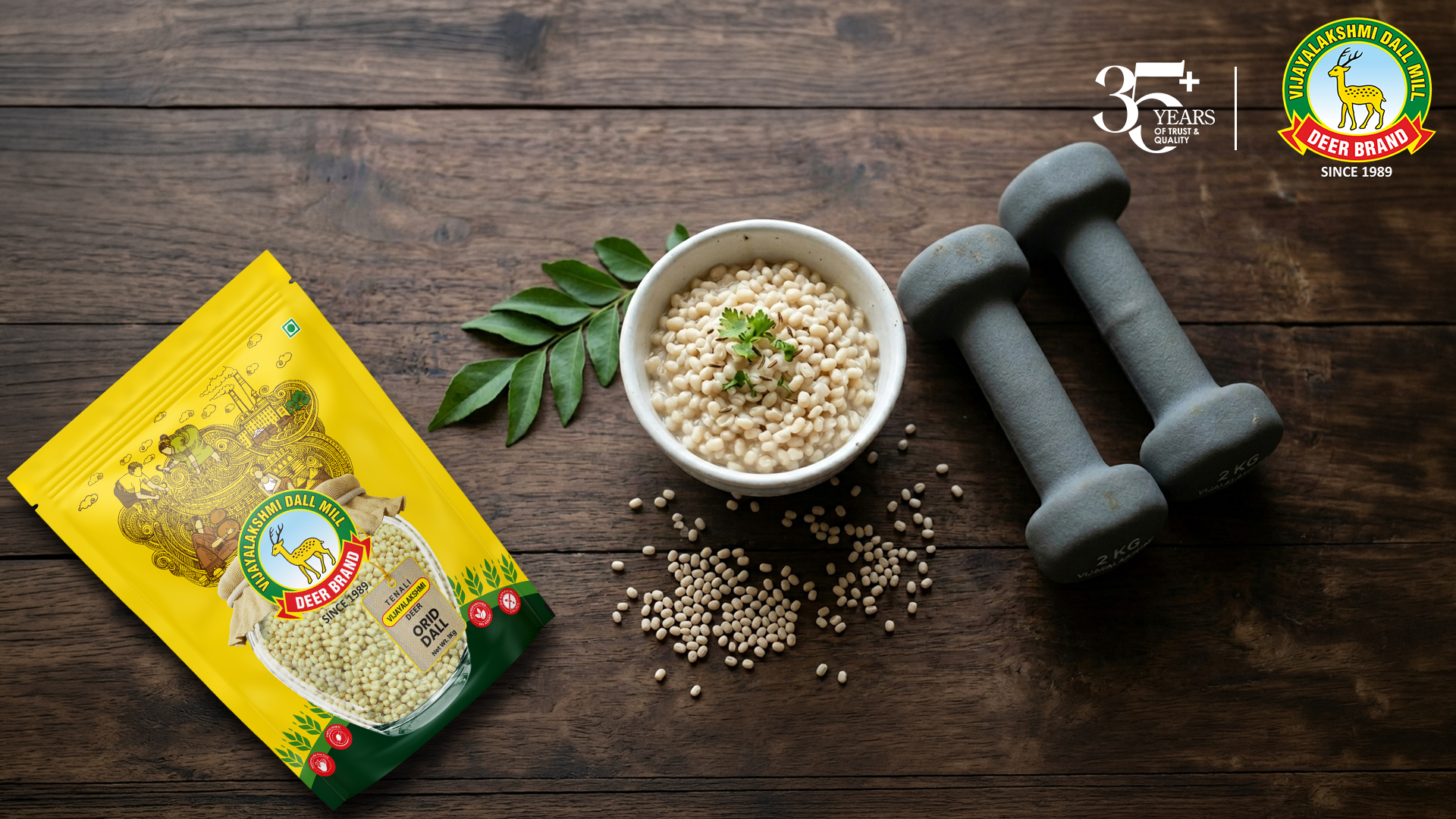
When people think about building muscle, they usually think about eggs, chicken, whey protein, and paneer. Urad dal rarely comes up in that conversation. But for vegetarians and vegans who rely on plant-based foods for their daily protein, urad dal is one of the most practical and nutritionally valuable options available in an Indian kitchen.
This post covers how urad dal supports muscle growth, how much protein it provides per serving, how it compares to other muscle-building foods, and the best ways to eat it if you are working on building or maintaining muscle.
Can Urad Dal Help Build Muscle?
Yes, urad dal can support muscle growth when eaten as part of a diet that meets your overall daily protein requirements. Muscle building requires two things: adequate protein intake and resistance training. Urad dal addresses the first requirement effectively.
With approximately 25g of protein per 100g of dry dal, urad dal is one of the richest plant protein sources in everyday Indian cooking. The protein in urad dal provides the amino acids your body uses to repair and build muscle tissue after exercise.
The key is eating enough of it consistently and pairing it correctly with other foods to ensure you are getting all essential amino acids your body needs for muscle protein synthesis.
How Much Protein Does Urad Dal Provide for Muscle Building?
Here is the protein you get from common urad dal preparations:
- 30g dry urad dal (one serving): 7 to 8g of protein
- Two to three idlis: 4 to 5g of protein from the dal component
- One bowl of boiled urad dal: 7 to 8g of protein
- One serving of dal makhani: 6 to 7g of protein
For muscle building, most sports nutritionists recommend consuming 1.6 to 2.2g of protein per kg of body weight per day. For a 70kg person actively training, this means approximately 112 to 154g of protein per day.
Two servings of urad dal per day contributes 14 to 16g of protein toward this target. When combined with other protein sources like paneer, curd, eggs, or other dals across the day, urad dal becomes a meaningful part of a muscle-building diet rather than the sole protein source.
What Amino Acids in Urad Dal Support Muscle Growth?
Muscle protein synthesis, the process by which your body builds new muscle tissue, is driven by specific amino acids. Here is how urad dal delivers on the most important ones:
Leucine Leucine is the most important amino acid for triggering muscle protein synthesis. It acts as a signal that tells your body to start building muscle after a training session. Urad dal contains approximately 1,800mg of leucine per 100g, which is a meaningful amount for a plant protein source.
Isoleucine Isoleucine works alongside leucine in muscle recovery and energy production during exercise. Urad dal contains approximately 1,000mg per 100g.
Valine Valine supports muscle metabolism and helps prevent muscle breakdown during exercise. Urad dal contains approximately 1,100mg per 100g.
Lysine Lysine is essential for muscle repair and collagen synthesis. It is also the amino acid that most grains are deficient in, which is why pairing urad dal with rice as in idli and dosa creates a complete protein that covers all essential amino acids.
Arginine Arginine supports blood flow and nutrient delivery to muscles during and after exercise. Urad dal contains approximately 1,600mg per 100g, making it a good source of this amino acid relative to other plant foods.
For a complete breakdown of all amino acids in urad dal, read our post on why urad dal is one of the best sources of plant protein.
Is Urad Dal a Complete Protein for Muscle Building?
Urad dal alone is not a complete protein. It is relatively low in methionine, one of the essential amino acids needed for muscle repair and overall protein synthesis. However this is easily solved through food pairing.
When you eat urad dal with rice as in idli, dosa, or dal rice, the combination provides all essential amino acids including leucine, isoleucine, valine, lysine, and methionine in a single meal. This makes the combination nutritionally comparable to a complete animal protein source for the purpose of muscle building.
For people who are serious about muscle building on a vegetarian diet, the practical approach is:
- Eat urad dal with rice at one or two meals per day for complete protein
- Add other protein sources like curd, paneer, or other dals across the day
- Eat protein at regular intervals throughout the day rather than in one large serving
How Does Urad Dal Compare to Other Muscle Building Foods?
Here is a comparison of protein content per 100g across common muscle building foods:
- Chicken breast (cooked): 31g
- Eggs (whole): 13g
- Paneer: 18g
- Curd (full fat): 11g
- Urad dal (dry): 25g
- Moong dal (dry): 24g
- Chana dal (dry): 20g
- Soybeans (dry): 36g
- Peanuts: 26g
- Whey protein powder: 70 to 80g
Urad dal compares very favourably against other common vegetarian protein sources. It has more protein than paneer, eggs, and curd per 100g and is comparable to peanuts. While it does not match whey protein or chicken, it is a practical everyday food that can be eaten in meaningful quantities as part of three meals a day.
The advantage urad dal has over many other plant proteins is its versatility. You can eat it as idli at breakfast, as dal rice at lunch, and as dal soup at dinner without it feeling repetitive. This consistency of intake across the day is what matters most for muscle building.
When Is the Best Time to Eat Urad Dal for Muscle Growth?
For muscle building, protein timing matters. Here is how to incorporate urad dal strategically:
Breakfast: Two to three idlis made from urad dal batter is an excellent pre or post workout breakfast. The fermented batter is easy to digest, provides a moderate amount of complete protein when paired with sambar, and gives sustained energy before a morning workout.
Post workout meal: A bowl of boiled urad dal with rice eaten within 1 to 2 hours after training helps provide the amino acids needed for muscle repair and recovery. Adding a small amount of ghee improves absorption of fat-soluble nutrients.
Lunch or dinner: Dal rice or dal makhani as a main meal provides a solid protein contribution alongside carbohydrates from rice which help replenish muscle glycogen after training.
Before bed: A small bowl of boiled urad dal before bed provides a slow-releasing protein source overnight when muscle repair and growth primarily occurs during sleep.
Does Fermentation Make Urad Dal Better for Muscle Building?
Yes, for two specific reasons.
First, fermentation reduces antinutrients like phytic acid and trypsin inhibitors that are present in raw urad dal. Trypsin inhibitors specifically block the action of trypsin, a digestive enzyme that breaks down protein. When fermentation reduces these inhibitors, more of the protein in urad dal becomes digestible and available for muscle building.
Second, fermentation partially breaks down the protein into smaller peptides that are absorbed more quickly by the digestive system. Faster absorption means the amino acids reach your muscles sooner after eating, which is relevant for post-workout nutrition.
This means that idli made from properly fermented urad dal batter is actually a more efficient protein source for muscle building than plain boiled urad dal, even though the raw protein content is the same.
How Much Urad Dal Should You Eat Per Day for Muscle Building?
For people actively trying to build muscle, two servings of urad dal per day is a practical and sustainable target. This provides 14 to 16g of protein from urad dal alone.
Practical daily intake for a muscle-building diet:
- Breakfast: two to three idlis with sambar (4 to 5g protein from dal)
- Lunch: one bowl of boiled urad dal with rice (7 to 8g protein)
- Additional protein: curd, paneer, eggs, or other dals to meet total daily target
The quality of the urad dal you use matters significantly. Naturally processed dal without chemical polishing agents retains its full protein profile and amino acid content. Over-processed dal may show similar protein figures on paper but delivers less in practice because the nutritional quality of the protein is compromised.
For urad dal that retains its complete nutritional profile, buy Deer Brand natural urad dal — naturally processed at our ISO and HACCP certified Tenali mills in Andhra Pradesh since 1989 and available on JioMart, Amazon, and Flipkart.
Frequently Asked Questions
Can vegetarians build muscle with urad dal? Yes. Urad dal provides approximately 25g of protein per 100g of dry dal and when paired with rice forms a complete protein with all essential amino acids. For vegetarians it is one of the most practical and accessible high protein foods for muscle building in an Indian diet. It should be part of a varied diet that includes other protein sources like curd, paneer, and other dals to meet daily protein targets.
Is idli good for muscle building? Idli is a good muscle building food when eaten as part of a protein-adequate diet. The fermented urad dal batter provides a more bioavailable protein than plain boiled dal. Two to three idlis with sambar is a nutritionally complete meal that supports muscle recovery and growth particularly as a post-workout breakfast.
How much protein do I need to build muscle? Most sports nutritionists recommend 1.6 to 2.2g of protein per kg of body weight per day for people actively trying to build muscle. For a 70kg person this is approximately 112 to 154g of protein per day. Urad dal contributes meaningfully toward this target but should be combined with other protein sources throughout the day.
Is urad dal better than paneer for muscle building? Urad dal has more protein per 100g than paneer at 25g versus 18g. However paneer provides a complete protein on its own while urad dal needs to be paired with rice for completeness. Both are valuable and the best approach is to include both in a varied muscle-building diet rather than choosing one over the other.
Does urad dal help with muscle recovery? Yes. The leucine, isoleucine, and valine in urad dal support muscle protein synthesis and recovery after exercise. The arginine content supports blood flow and nutrient delivery to muscles. Eating urad dal within 1 to 2 hours after training as part of a balanced meal with rice helps provide the amino acids needed for muscle repair.
The Bottom Line
Urad dal is a genuinely valuable food for muscle building, particularly for vegetarians who need to meet daily protein targets from plant sources. Its high protein content, broad amino acid profile, and natural complementarity with rice make it one of the most efficient plant proteins available in everyday Indian cooking.
The key is eating it consistently across the day in combination with other protein sources, choosing fermented preparations like idli where possible for better protein bioavailability, and starting with good quality naturally processed dal that retains its full nutritional profile.
For urad dal that delivers complete nutrition in every serving, shop Deer Brand natural urad dal — available in 500g, 1kg, and 5kg packs on JioMart, Amazon, and Flipkart.
Published by the Deer Brand Team — Vijayalakshmi Dall Mills, manufacturers of premium natural urad dal in Tenali, Andhra Pradesh since 1989.