Best Urad Dal for Idli and Dosa: A Complete Home Cook’s Guide (2026)
If your idlis keep coming out dense or your dosa batter refuses to ferment overnight, the problem is almost certainly your urad dal – not your recipe. The type and quality of urad dal you use determines 80% of your result, and most home cooks never realise this until they switch brands.
This guide breaks down everything you need to know to pick the best urad dal for idli and dosa – from the difference between whole, split, and polished varieties, to the exact signs of fresh stock, to the mistakes that silently ruin your batter every time.
Which Urad Dal Is Best for Idli and Dosa?
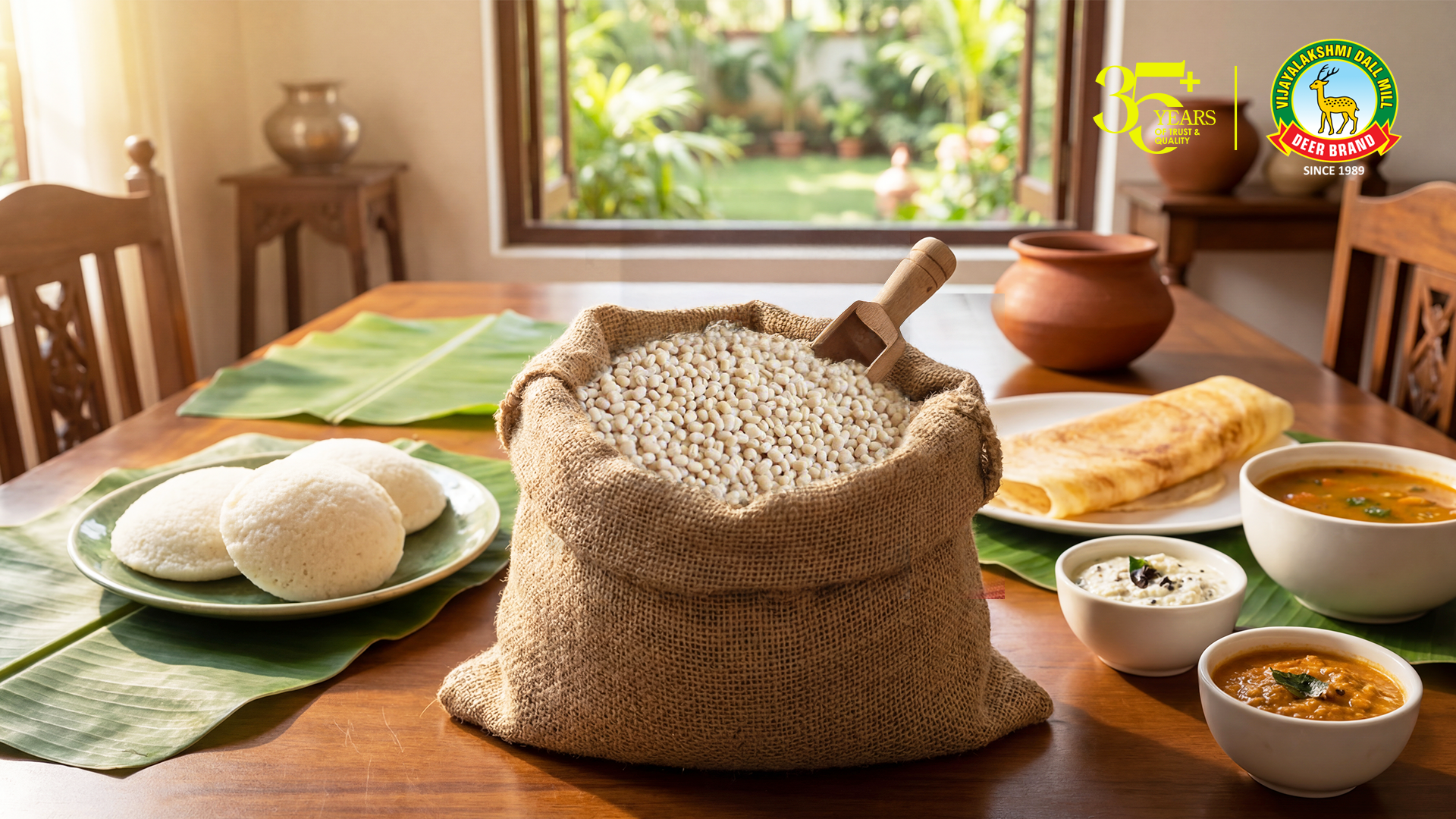
Whole, unpolished urad dal is the best choice for both idli and dosa. It retains its natural mucilage – a gel-like substance in the bran layer that is the engine of fermentation. Without it, your batter simply won’t rise the way it should, and your idlis will be flat, dense, and rubbery instead of light and fluffy.
Split or polished varieties lose varying amounts of this mucilage during processing, which is why batter made from them often struggles to ferment properly – especially in cooler weather or air-conditioned kitchens.
Whole vs Split vs Polished vs Unpolished: What’s the Difference?
Before you buy, it helps to understand exactly what you’re looking at on the shelf. Here’s a clear breakdown:
Whole Unpolished Urad Dal
- Best for: Idli, dosa, medu vada
- Mucilage retained: Full – ferments excellently every time
- Appearance: Matte cream-white interior, natural dark skin
- Verdict: ✅ The only type recommended for idli and dosa batter
Whole Polished Urad Dal
- Best for: Idli (less reliable results)
- Mucilage retained: Partial – fermentation can be inconsistent
- Appearance: Unnaturally bright white, shiny or glossy surface
- Verdict: ⚠️ Works sometimes, but not dependable
Split Unpolished Urad Dal
- Best for: Dosa (thinner batter), some dal dishes
- Mucilage retained: Partial – moderate fermentation
- Appearance: Flat halves, off-white, no skin
- Verdict: ⚠️ Acceptable for dosa, not ideal for idli
Split White (Dehusked) Urad Dal
- Best for: Papads, dal dishes – not batter
- Mucilage retained: Minimal – poor fermentation
- Appearance: Bright white, completely skinless
- Verdict: ❌ Not suitable for idli or dosa batter
The takeaway: For consistently soft idlis and crispy dosas, whole unpolished urad dal is the only variety that delivers reliable results every single time.
How to Tell If Your Urad Dal Is Fresh
Even the right type of urad dal can let you down if the stock is old. Here’s what to check before you cook:
- Colour: Fresh whole urad dal should be a uniform cream-white on the inside when split open. A yellowed or grey tinge means it has been sitting in a warehouse too long.
- Smell: Fresh dal smells clean and slightly earthy. Any mustiness, sourness, or chemical smell is a red flag – either it’s old, or it has been treated with polishing agents.
- Texture: Firm and slightly rough. If it crumbles into powder easily when pressed, it’s old or poorly stored.
- Batter rise: The ultimate test. Good quality whole unpolished dal should produce a batter that visibly rises and turns airy within 8 hours at room temperature. If it doesn’t, the dal – not the weather – is usually the culprit.
5 Common Mistakes Home Cooks Make with Urad Dal
Even experienced cooks make these mistakes. Check if any of them sound familiar:
- Using polished urad dal for idli batter. Polished dal looks clean and premium, but the polishing process strips the bran layer that contains the mucilage responsible for fermentation. The result is a batter that looks right but never rises enough.
- Buying old stock from unbranded loose bins. Loose dal from open bins has no batch date, no traceability, and no guarantee of freshness. The longer it sits, the worse your batter will be.
- Soaking for too long or too short. Whole urad dal needs 4–6 hours of soaking, not more. Over-soaking makes the batter too thin and sour. Under-soaking means the grains don’t grind smoothly enough to trap air during fermentation.
- Grinding too coarsely or too fine. The batter should be thick, smooth, and slightly airy after grinding – like a thick mousse. Too coarse and it won’t ferment evenly. Too fine and it loses the airy texture that makes idlis fluffy.
- Using the same dal brand out of habit, never questioning it. If your idlis have never been quite as good as the ones at your favourite restaurant, there’s a good chance your dal is the variable you’ve never tested. A single switch to high-quality unpolished urad dal is often all it takes.
Why Hotel Kitchens and Restaurants Use a Different Grade of Urad Dal
If you’ve ever wondered why restaurant idlis are consistently softer than homemade ones, the answer isn’t a secret recipe or a special technique – it’s the dal.
Commercial kitchens that serve hundreds of idlis a day cannot afford inconsistent batter. They need a dal that ferments reliably, batch after batch, regardless of the season. That means they source exclusively from manufacturers who can guarantee:
- Consistent grain size – uniform grains grind evenly and ferment at the same rate
- No adulteration – no mixing of broken grains, stones, or lower-grade varieties
- Fresh stock – short time between processing and delivery, not months in storage
- Natural processing – no chemical polishing agents that interfere with fermentation
This is the standard that Deer Brand urad dal has maintained across hotel and restaurant kitchens in Andhra Pradesh, Telangana, Kerala, Karnataka, Odisha, and Delhi-NCR for over 35 years. The same grade available to hotels is what goes into every 500g and 1kg pack for home use.
What Makes Deer Brand Urad Dal Different
Vijayalakshmi Dall Mills has been processing urad dal in Tenali, Guntur District since 1989. The flagship Deer Brand range is strictly whole and unpolished – no oil, no water, no chemical agents are added to improve appearance or add weight.
Every batch is processed across four ISO and HACCP certified units with a combined capacity of 240 tonnes per day. That scale ensures fresh stock rather than aged inventory, and the certification means every stage – from cleaning to grading to packing – meets documented quality standards.
The result is a dal that home cooks across South India describe the same way: batter that rises every time, idlis that are consistently soft, and dosas that crisp up the way they should.
How to Use Whole Unpolished Urad Dal for Best Results
Follow these steps for a batter that works every time:
- Measure – Use a 1:3 ratio of whole urad dal to idli rice (or 1:4 for thinner dosa batter).
- Rinse – Rinse the dal 2-3 times until the water runs clear.
- Soak – Soak for 4-6 hours in cool water. Do not exceed 6 hours.
- Grind – Grind with minimal cold water until the batter is thick, smooth, and airy. It should fall off a spoon in a thick ribbon.
- Mix and salt – Combine with ground rice batter, add salt, and mix well with your hand (body heat helps activate fermentation).
- Ferment – Leave covered at room temperature for 8-12 hours. In cooler weather, place in a warm spot or inside an oven with just the light on.
- Cook – Batter is ready when it has visibly risen and smells slightly tangy. Steam idlis for 10-12 minutes. Spread dosas on a hot iron pan.
Frequently Asked Questions
Which urad dal is best for idli? Whole, unpolished urad dal is best for idli. It retains its natural mucilage – the gel-like compound that drives fermentation – giving idli batter the lift it needs to produce soft, fluffy results. Split or polished varieties lose varying amounts of this mucilage during processing, making fermentation unreliable.
Can I use polished urad dal for idli batter? You can, but results will be inconsistent. Polished urad dal has had its bran layer partially or fully removed, which reduces the mucilage content that triggers proper fermentation. In warm weather it may still work reasonably well, but in cooler or air-conditioned environments your batter is likely to fall flat.
Why is my idli batter not fermenting? The most common cause is polished or old urad dal. Other reasons include water that is too cold during soaking, over-soaking (beyond 6 hours), or grinding the batter too thin. Switching to fresh, whole unpolished urad dal resolves the issue in most cases without any other changes to your method.
Whole urad or split urad for dosa? Whole unpolished urad dal makes better dosa batter because it ferments more fully, producing a batter with more air bubbles – which is what gives dosas their characteristic crispiness. Split urad dal produces a thinner, flatter batter that works in a pinch but doesn’t deliver the same texture.
How long should I soak urad dal for idli batter? Soak whole urad dal for 4-6 hours. This is enough time for the grains to hydrate fully and grind smoothly. Soaking beyond 6 hours can cause the dal to ferment prematurely in the soaking water, making the final batter too sour and thin.
The Bottom Line
The difference between a perfect idli and a disappointing one often comes down to a single decision made at the grocery store. Whole, unpolished urad dal – fresh, clean, and free of chemical treatment – is what your batter needs to ferment reliably and deliver the soft, airy texture that makes South Indian breakfast worth waking up for.
If you’ve been blaming your recipe, your grinder, or the weather, try changing your dal first. The results usually speak for themselves.
Ready to make idlis that actually rise every time? Try high-quality urad dal for idli and dosa from Deer Brand – natural, unpolished, and trusted by South Indian hotel kitchens and home cooks since 1989.
Published by the Deer Brand Team – Vijayalakshmi Dall Mills, manufacturers of premium unpolished urad dal in Tenali, Andhra Pradesh since 1989.